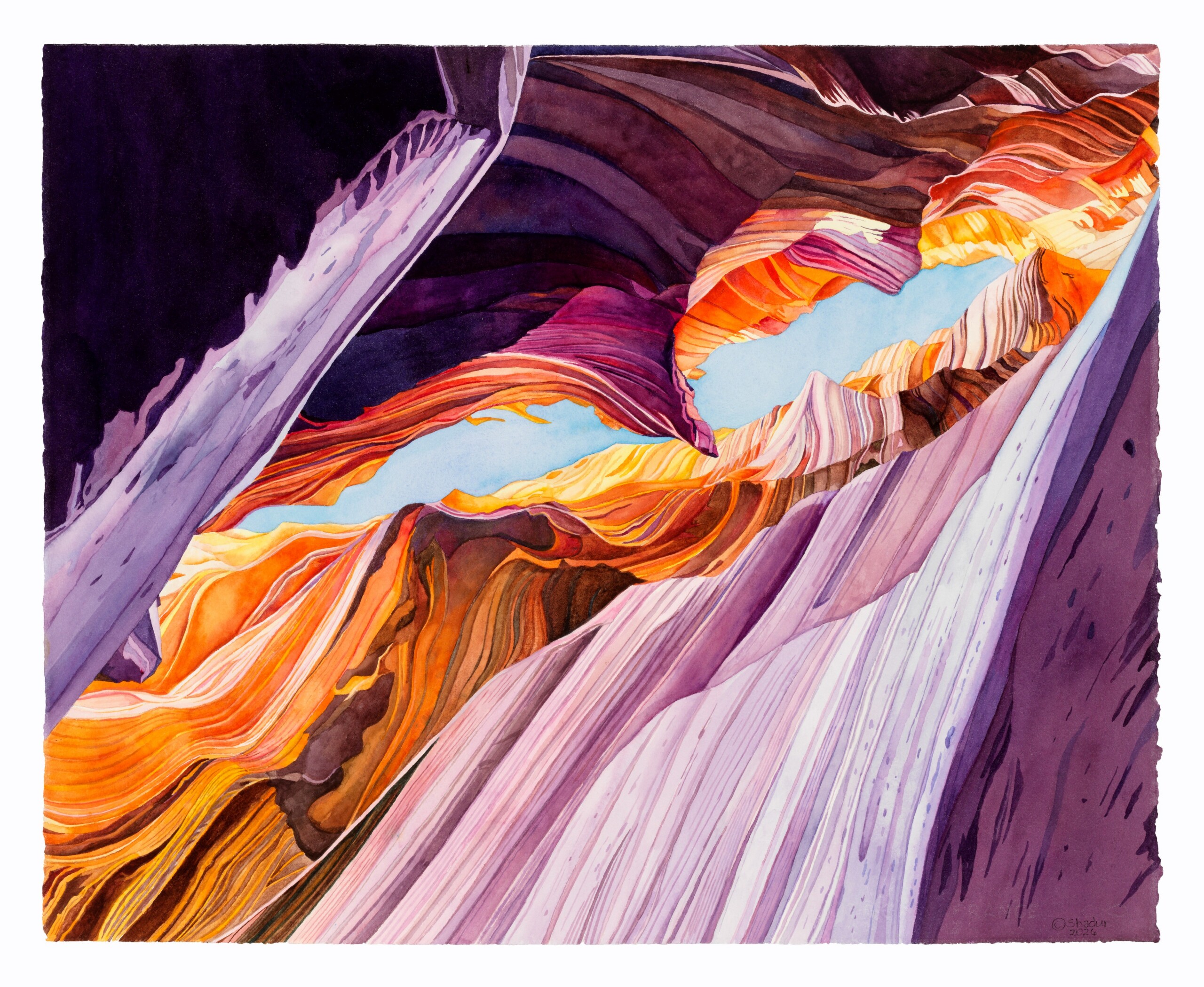
Plunge (Antelope Canyon), watercolor, 21x24.5 inches
-Beth, we'd love to hear your story and how you got to where you are today, both personally and as an artist.
I am a professional artist in my mid-to-late career who has been working as an artist since receiving my BFA in 1975 and MFA in 1980. After I graduated from Brown University, they gifted me the Watson Fellowship to pursue the documentation and creation of murals in Mexico and then Western Europe. I spent almost two years in Scotland, doing community murals in the Special Unit of Barlinnie Prison, working with Town Artist David Harding in Glenrothes, leading a mural project in a program for at-risk youth, and then creating a community art archive for the Third Eye Center.
After returning to the US, I began to exhibit my work professionally and also create murals with community groups and as commissions, and then also got my MFA. For many years, I taught drawing, painting, and 2d design at numerous colleges, universities, museums, and art centers. I also did many artist-in-residencies in schools to do murals and watercolor workshops with students.
I also serve as a curator of various exhibitions, most especially the Poetic Dialogue Project, in which I have paired many contemporary visual artist with poets to create collaborative works. These exhibitions have been held in museums and university galleries in the US and abroad. I also worked from 2012-2024 at Prairie State College in Chicago Heights, IL as the Gallery Director, and created over 110 exhibitions in that time with artists from the Midwest and other parts of the US.
Since I began my career, I have exhibited widely in both the US and abroad, and have completed over 150 murals as both private and public commissions and as community projects. For my studio work, I tend to work in series, addressing the social issue of stewardship for our natural environment as well as other social issues. My latest work in The National Park Project (with the Antelope Canyon works as the latest version of these works) follows many years of working on this theme. My earliest work in the 1980s addressed endangered species, and more recently, I have done artist-in-residencies in the pristine environments of Banff Provincial Park, Iceland, and Ireland, and have travelled, hiked, researched and photographed various National Parks.
On my last National Park trip to the Grand Canyon, I visited Antelope Canyon in northeast Arizona, and since then, I have been fascinated with the various forms, colors, and shapes of this sacred landscape.
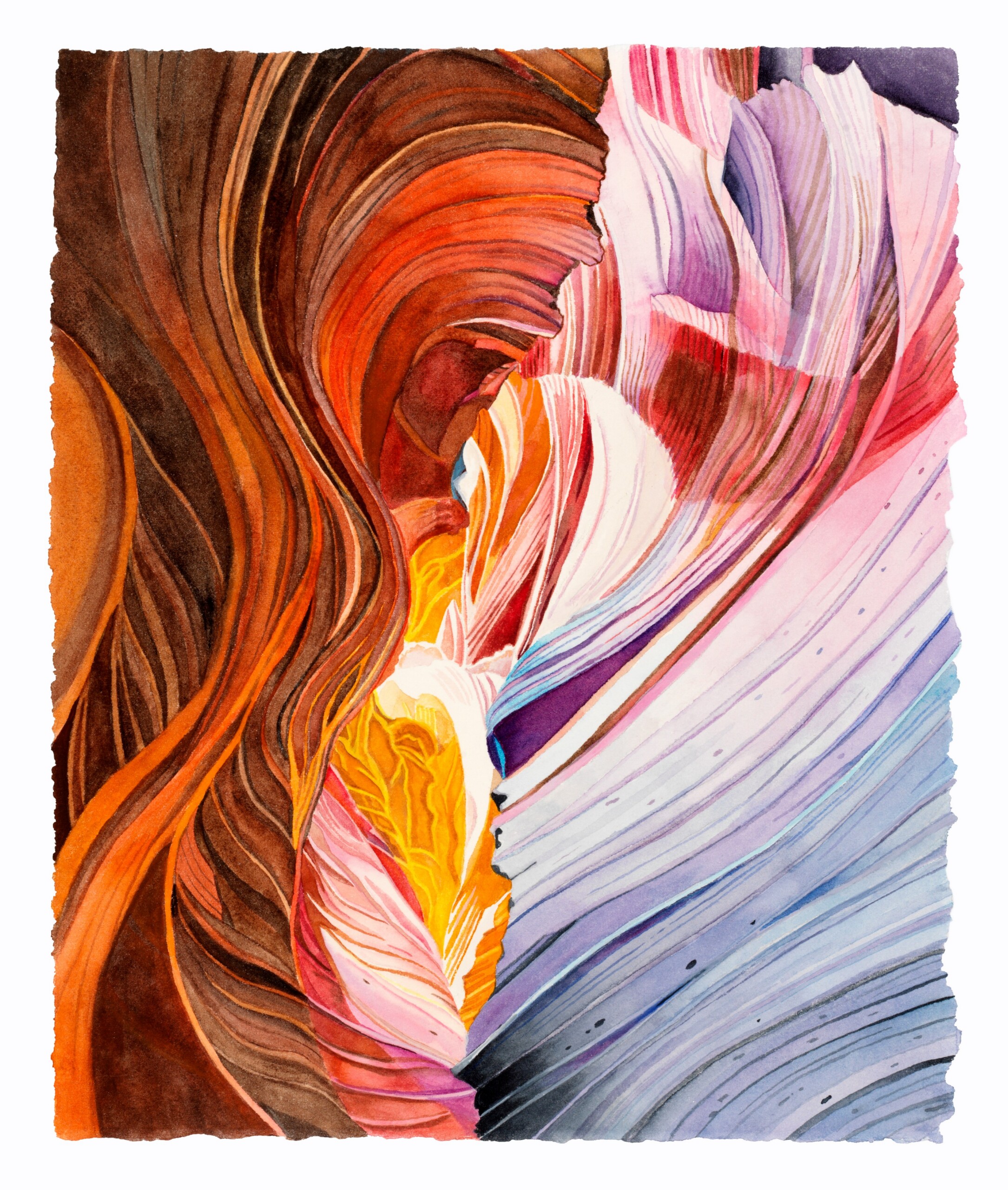
Bouclée (Antelope Canyon), watercolor, 16.5x14.5 inches
-The series title “Wondrous Strange” comes from a line in Hamlet. It adds such a nice layer to this work. How did that line come to mind, and what does it capture about Antelope Canyon for you?
I was searching for a title for this exhibition and series and came across the quote from Horatio in Hamlet, as Horatio views the ghost of Hamlet’s father. But Hamlet wants Horatio to accept this ghost as if it were any stranger. The words for me resonate in Antelope Canyon, because when there, one cannot believe what they are seeing, as if the forms are an apparition, not reality. At times, when I show the photos I took of the Canyon to others, they truly cannot believe the curving, shifting, magnificent and colorful forms of sandstone are real! I felt in total “awe” as I walked through with my tour, but continued to photograph these almost unbelievable forms. They are certainly “strange”, as if they are imaginary, with the beauty almost overwhelming! Wondrous strange certainly describes the experience of touring both Upper and Lower Canyons. I also consider these forms to be sacred, as the area is considered a “tension” point between heaven and earth by the Diné tribe, who own the land and lead the tours through Antelope Canyon.
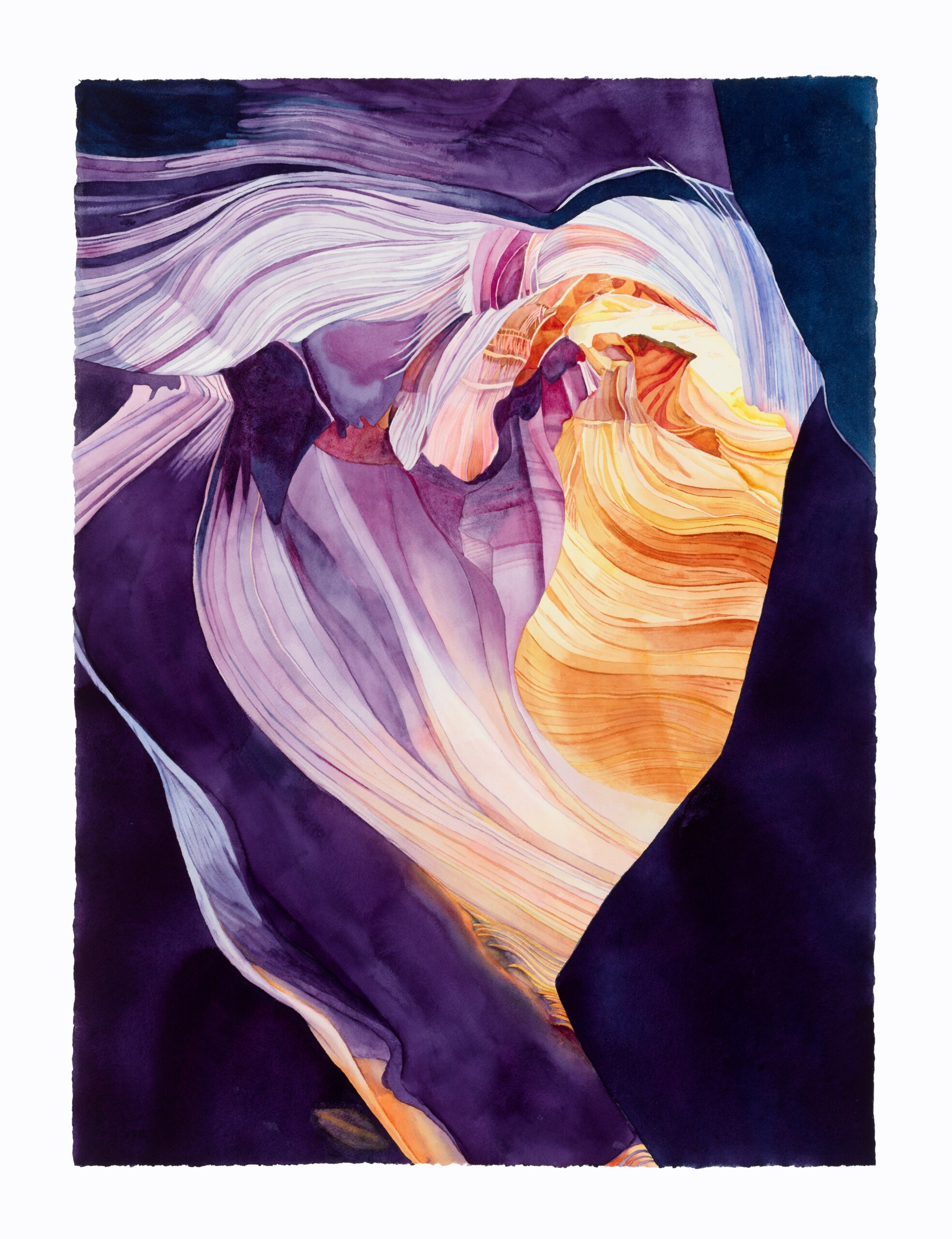
Heartfelt (Antelope Canyon), watercolor, 36x28 inches
-The way you crop these canyons is compelling, and it almost reads as abstract. How do you decide on the composition, and how important is cropping to the way you see these landscapes?
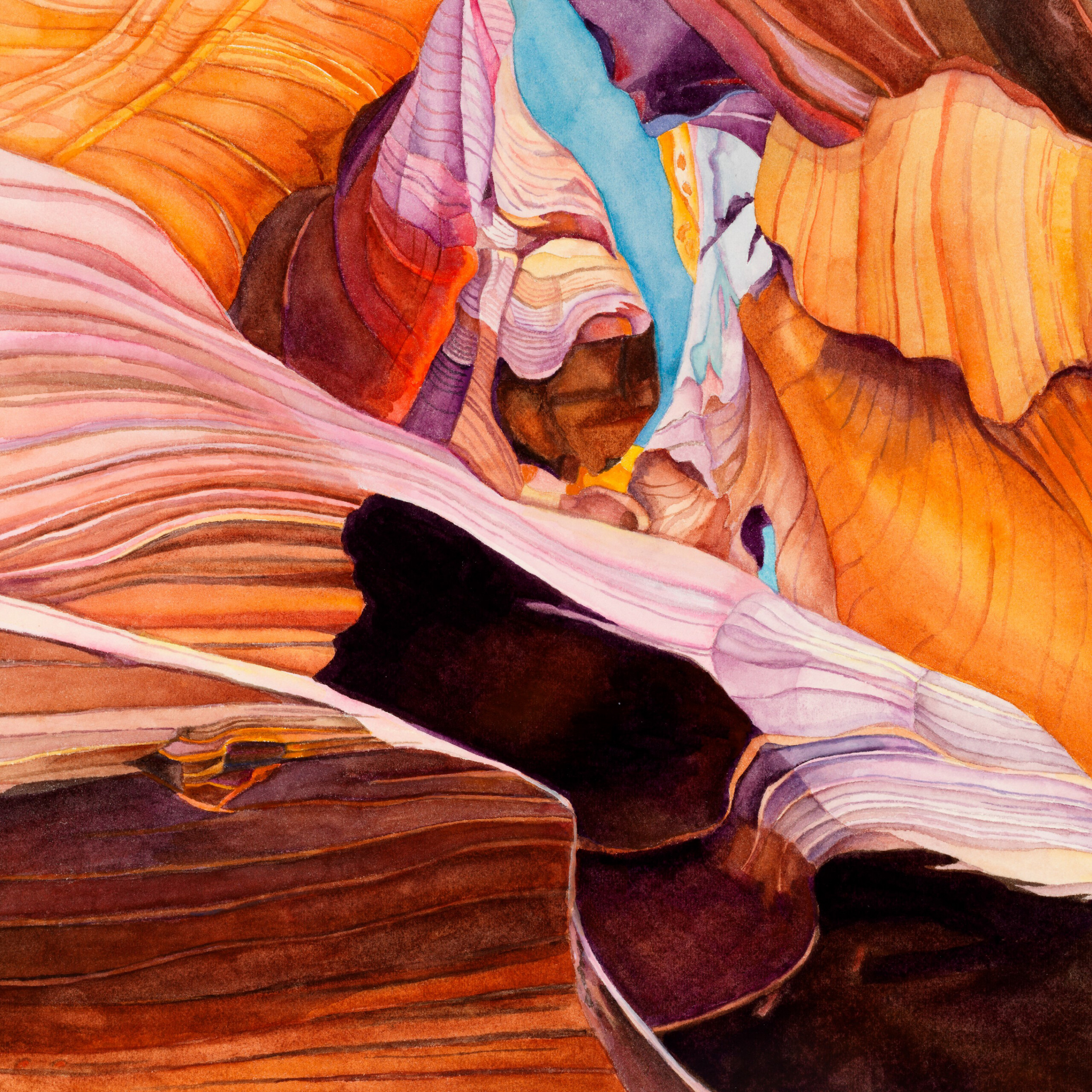
I am working here directly from my own photographs, so that the cropping took place in the use of the camera. But, since the tour was during Covid, and for a limited time of stopping at each location, I actually took them with my cell phone. I used the phone as if I were composing the works. The forms themselves were at times dizzying, and I was able to capture that in each location. I must have taken 40 pictures each time the tour stopped in about 20 locations! Then, I filtered through the photos for the strongest compositions, allowing for not only the beauty of the forms to take precedence, but looked for the dynamic tension present in the composition.
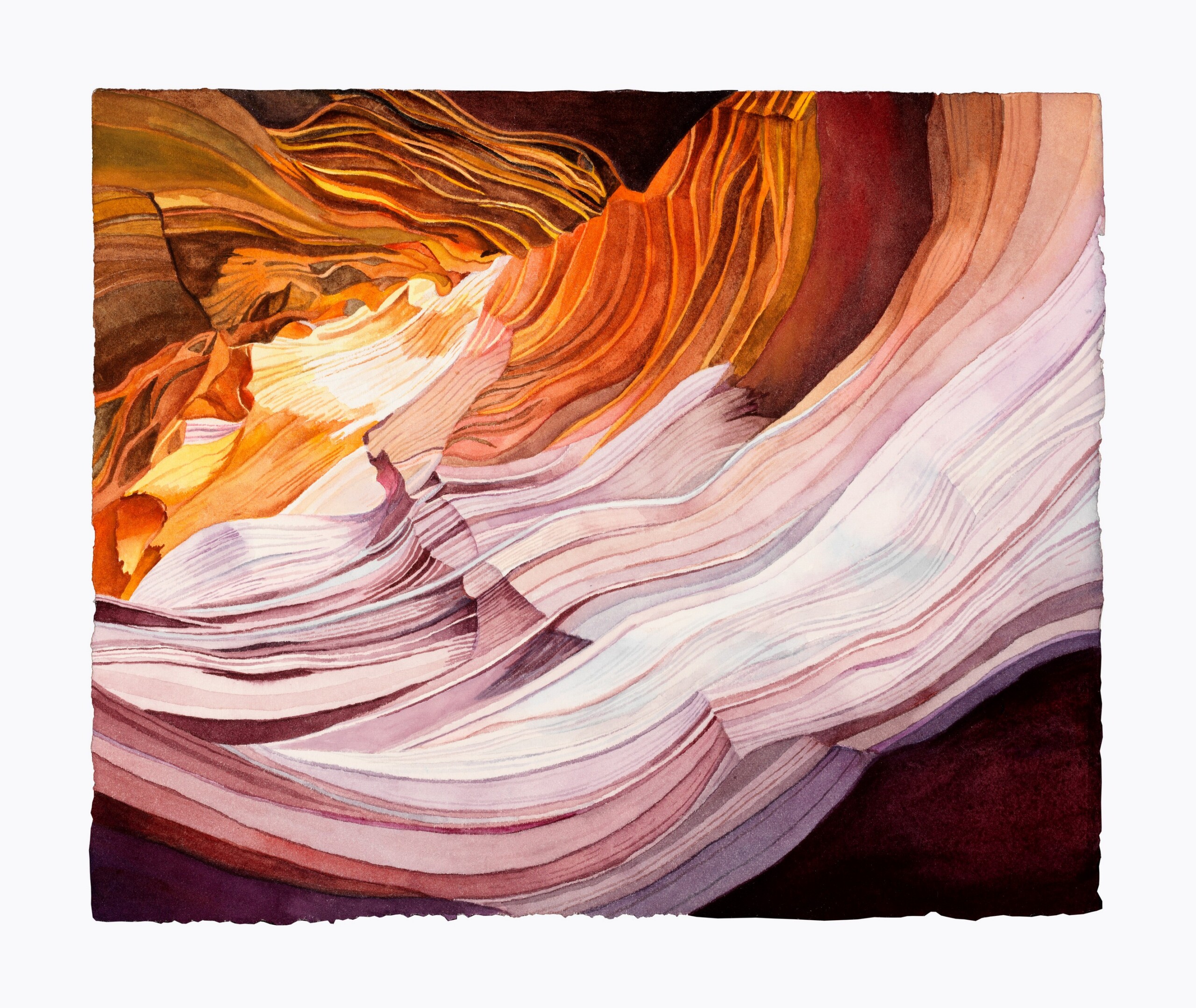
Fluid (Antelope Canyon Tribal Park), watercolor, 14x16 inches
-You capture the movement of water so beautifully in the curves of the stone, yet the paintings contain no water. How does that mix of absence and beauty find its way into your work?
It is interesting that you ask about water, because these amazing forms were carved by water 2-3 million years ago. And there are certainly current flash floods through the canyons that continue to shape the forms. So, the feeling of perhaps waves, striations in watery forms create the essence of the various shapes throughout the canyon. The sandstone is at times smooth from the wearing down of water, and at other times, retains the “stripes” of the force of water moving through. I do emphasize that in the works, as well as the movement of color as you look through from dark to light in the Upper Canyon, and from cooler to warmer tones in the Lower Canyon. While viewers think I am exaggerating the color, I truly am not. There are purples, pinks, oranges, golds, yellows, blues, reds, siennas and browns to be seen throughout the canyon.
I think that the tipping of perspective that I emphasize, too, makes one associate the forms with water.
The beauty really comes from the forms and colors themselves that are apparent as you walk through. I truly feel that I am “channeling” the beauty in my paintings, just reflecting the beauty I saw.
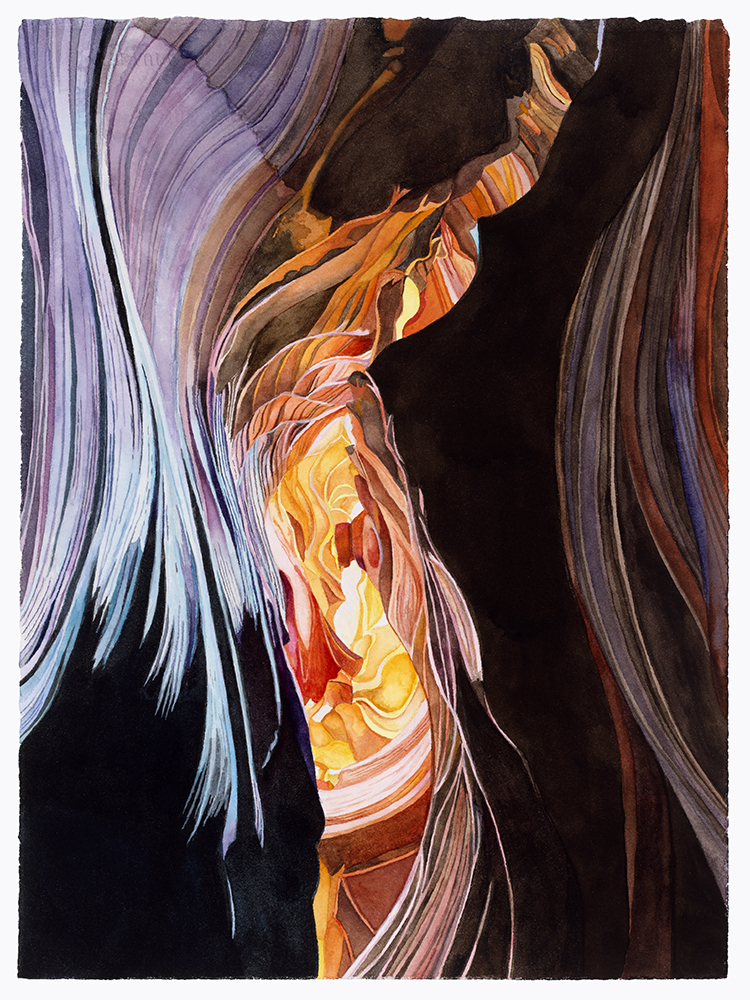
Unveiled (Antelope Canyon), watercolor, 36x28 inches
-What's the best way for someone to check out your work and provide support?
Check out my work at www.bethshadur.com(opens in new tab). Also, I have an Instagram account where I post my work: www.instagram.com/bethshadur(opens in new tab) and facebook, www.facebook.com/bethshadur(opens in new tab). I also list any exhibitions I am having or have a work in on these social media platforms.
To support my work, I am really convinced after all these years of painting that these works are my best pieces! I am enjoying painting them so very much, and approach each new one with enthusiasm. To fully support my work, you can certainly buy my work for your enjoyment. I simply want my work to go where they will be loved and enjoyed.
Statement
My work has, of late, addressed the fragility of those places that we consider sacred and pristine. This work has led me to do residencies in Ireland, Banff, and Iceland, and it has allowed me to work on pieces that address the human impact on the most remote and exquisite of environments. Climate change, industry, tourism and pollution have threatened places that once were considered wild and remote.
In 2017, I began a new series based on the National Parks and Tribal Parks, presenting the beauty of the natural environment in various iconic landscapes. For various National Parks, I have done large works that tell the story of these parks, including how the landscapes and natural environments were utilized and cared for by Native peoples. I also include how the land was then “discovered” by Euro-American explorers and how the land then became a National Park. I include current threats to the natural areas. I then include smaller details captured from my hiking and photographing these unusual landforms.
During my exploration of the area of Grand Canyon National Park, I was privileged to visit Antelope Canyon Tribal Park, land owned by the Diné people. This slot canyon in northeast Arizona is simply stunning, with its unusual colors, water-carved landforms, and wondrous glimpses into a truly pristine landscape protected by the Diné.
The Navajo people call Upper Antelope Canyon Tsé bighánílíní, which translates to "the place where water runs through rocks". This name describes the flash floods and water erosion that carved the smooth, wave-like shapes into the Navajo Sandstone over thousands of years. They call the Lower Antelope Canyon Hasdestwazi, meaning "spiral rock arches". Many Pronghorn antelope are seen throughout the area; hence, the English name became Antelope Canyon. One can tour the area only through guided tours, due to the incidence of flash floods that can run through the canyons.
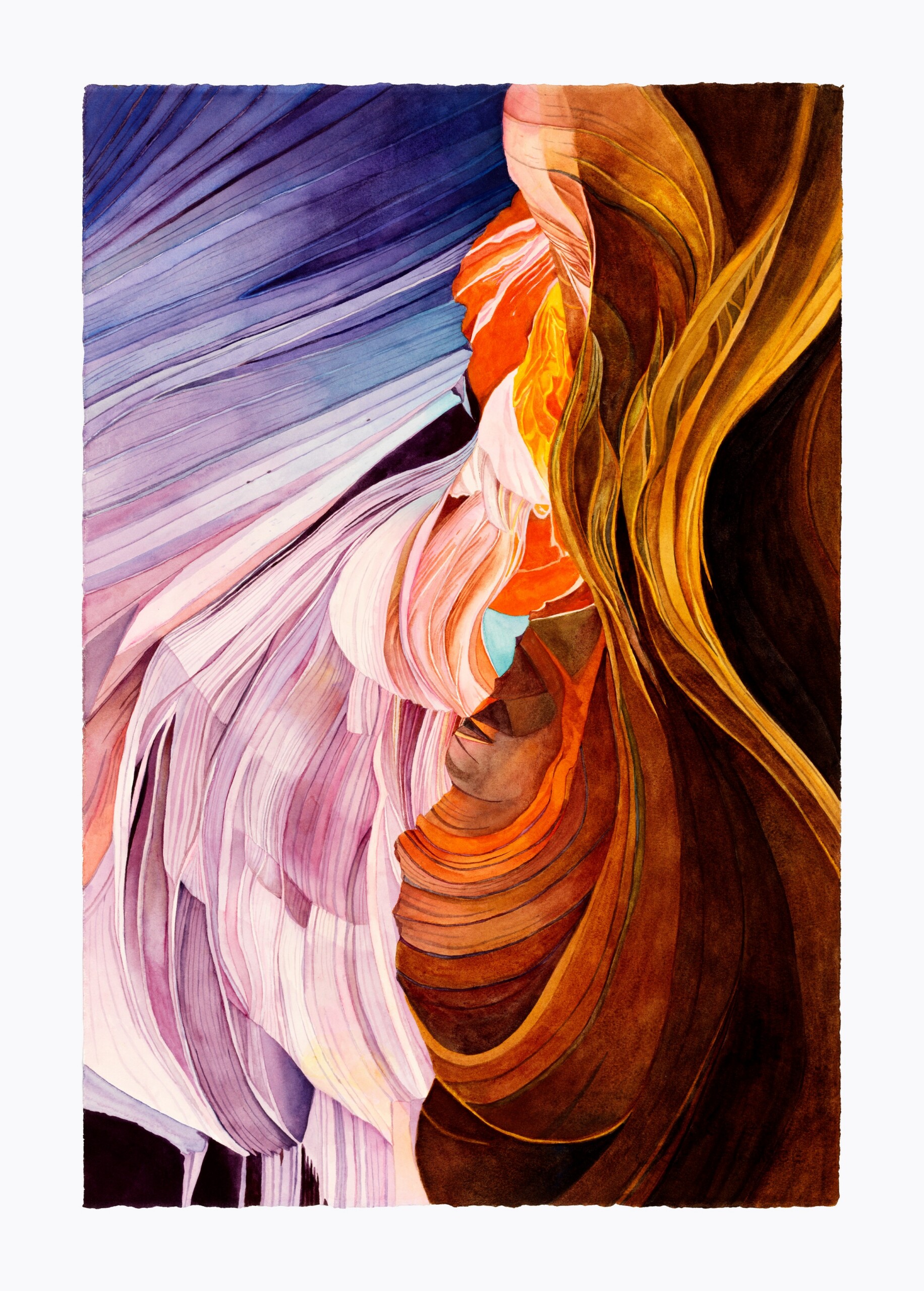
Whirl (Antelope Canyon Tribal Park), watercolor, 28x21 inches
This landscape has inspired a huge series of paintings, a selection of which can be seen in “Wondrous Strange “ (taken from Shakespeare’s Hamlet). All works are based on photos I took during our guided hike through this sacred space. These works are meant to remind us of our responsibility as global citizens to care for our planet and sacred spaces. For many years, my work has addressed the fragility of nature and reflected my vast love for nature. It is only with strong attention to our human impact that we can reverse what are dangerous trends; we must take action now before it is too late.
Bio
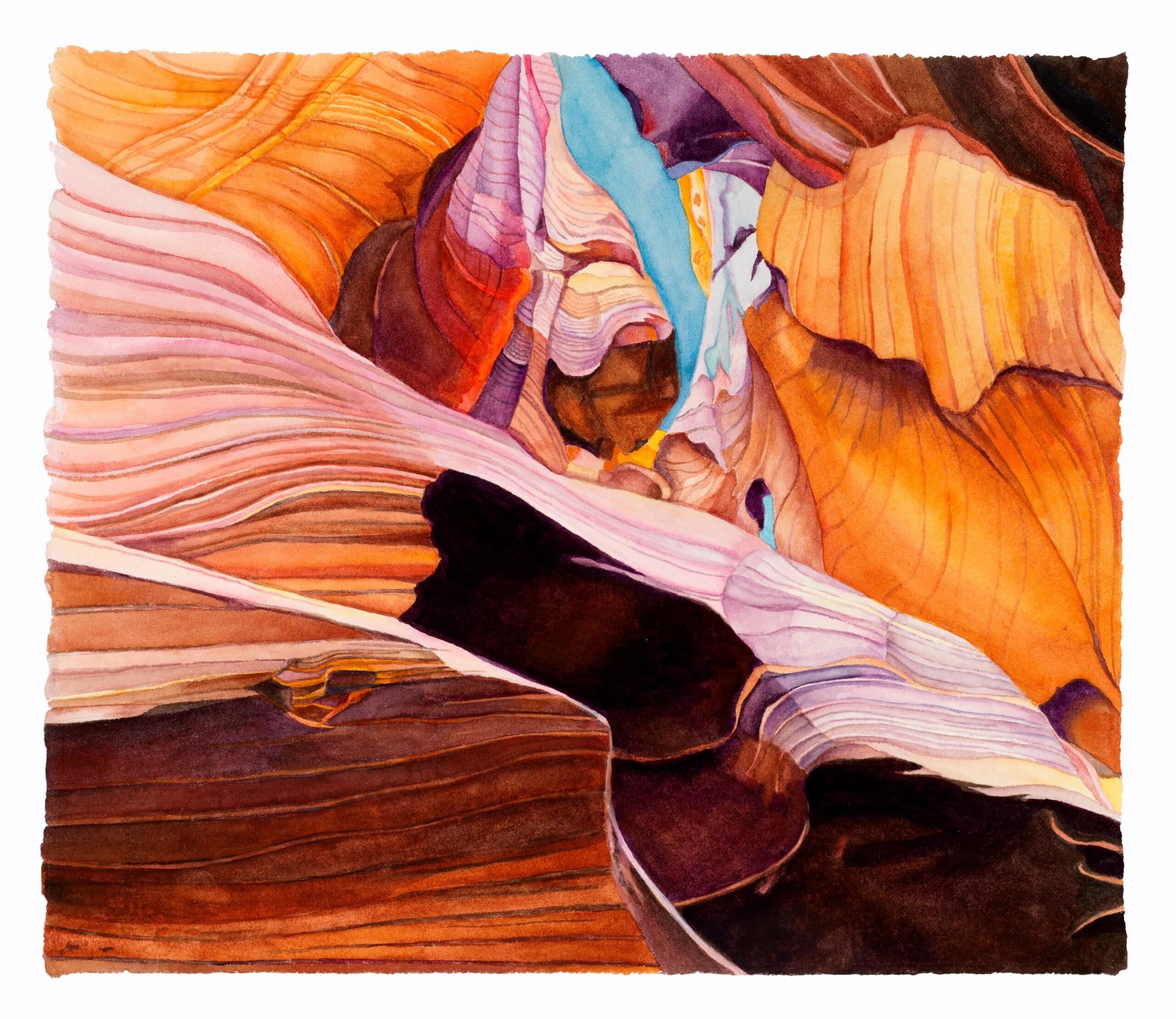
Intricacies (Antelope Canyon),watercolor
Beth Shadur, an acclaimed artist based in Highland Park, Illinois, is renowned for her evocative watercolor paintings and extensive contributions to public art. With a career spanning several decades, Shadur has exhibited her work in numerous prestigious venues, including the Art Institute of Chicago and The Drawing Center in New York City. Her artistic journey is marked by more than 150 public murals completed across the United States and Great Britain, demonstrating her commitment to creating art that engages communities and transforms public spaces.
Shadur's work primarily explores the intricate relationship between humanity and the natural world, often focusing on the impact of human activity on pristine landscapes. Her current undertaking, The National Park Project, exemplifies this theme, as she delves into the historical and contemporary threats facing these treasured environments. Through a unique blend of realism and collage, Shadur assembles images with meticulous precision, using vibrant watercolor techniques that push the boundaries of traditional applications. Her art not only captures the beauty of nature but also conveys deeper ideas of value and spirituality.
An alumna of Brown University and the University of Illinois-Chicago, where she earned her MFA, Shadur has been recognized with numerous awards and fellowships, including the prestigious Thomas Watson Fellowship. Her dedication extends beyond creation; she has served as a visiting artist and educator at various academic institutions and was the Gallery Director at Prairie State College from 2012 to 2024. Shadur's influence also reaches into the realm of curation, where she continues to shape the art community as an independent curator.
Beth Shadur's work is celebrated not only in exhibitions but also in publications like Twentieth Century Watercolors by Abbeville Press. Her artistic vision, coupled with her educational pursuits and extensive community engagement, underscores her long-term goal of creating works that intrigue and challenge viewers while seeking greater recognition for her contributions to the art world. As a member of the Space 900 Artists Collective in Evanston, she continues to inspire audiences with her innovative and thought-provoking pieces, solidifying her legacy as a steward of art and nature.