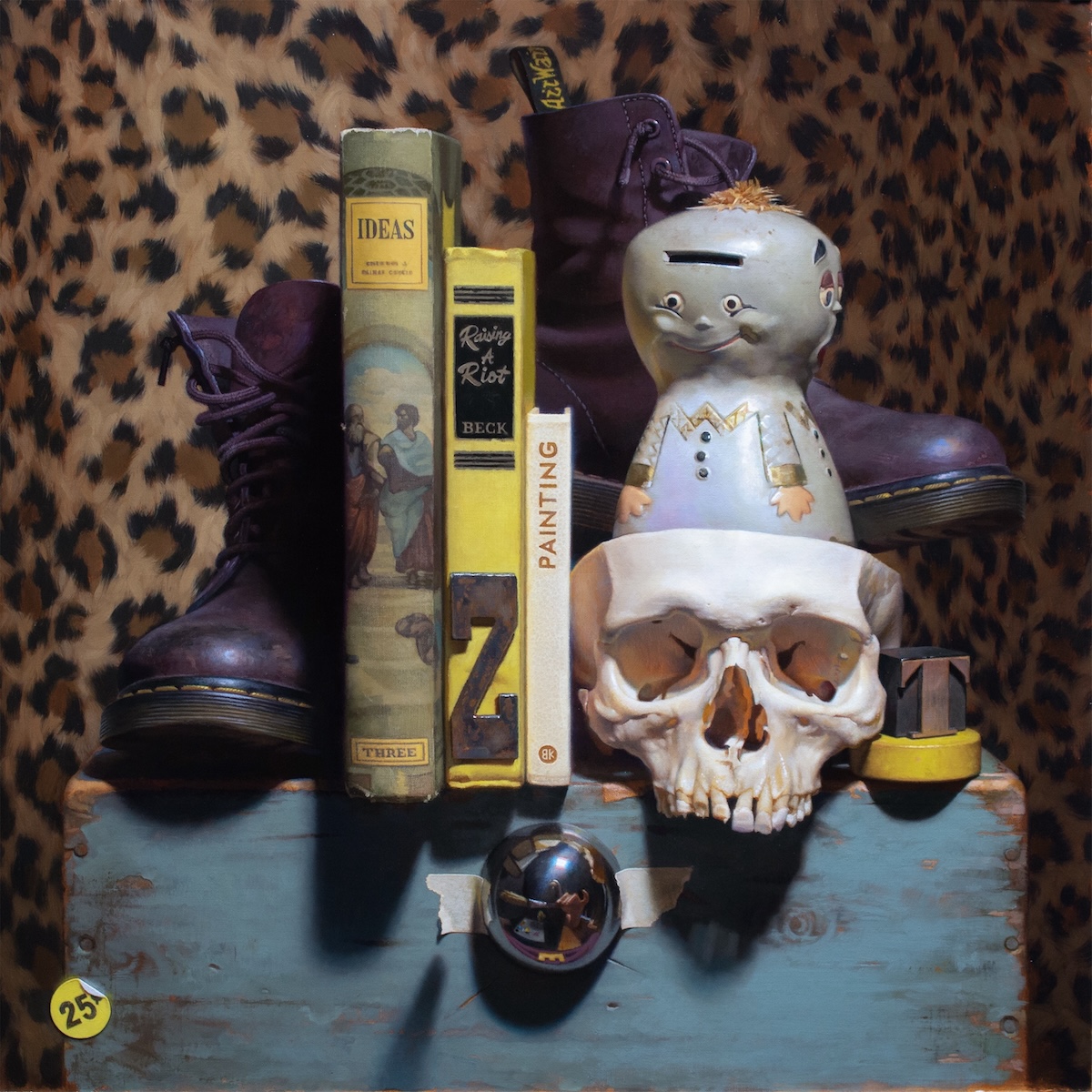
You Can Do Anything, Magic Skeleton, oil on canvas panel, 16x16 inches
-Julie, we'd love to hear your story and how you got to where you are today, both personally and as an artist.
My path to becoming an artist was pretty indirect. I grew up in Rochester, New York, and initially went to college with an interest in engineering and math. Art was always something I loved, but not only was I not very good naturally, but I had financial planner parents so art wasn’t a solid option for an actual career path.
For about ten years, I was essentially self-taught while working full-time as a freelance graphic designer and video editor. I was making art because I wanted to, even before I had a clear idea of what a life as an artist could look like.
In my early 30s, after moving to Massachusetts, I discovered the Academy of Realist Art Boston. I had never experienced atelier training before, and it completely changed the way I approached painting. Learning how light, form, value, and drawing actually worked gave me a technical foundation that allowed me to pursue much bigger ideas.
I eventually became an instructor and then Assistant Director at ARA, where I've been since 2013. Teaching has become a really important part of my life as an artist. One of the things I value most about the school is that we emphasize skill rather than prescribing a particular style. I think technical ability should give you more freedom, not less.
My own work has grown out of that combination: the experimentation I developed as a self-taught artist and the technical discipline I gained through atelier training. I use realism as a tool, but I'm not particularly interested in realism for realism's sake. I'm interested in using incredibly familiar, carefully painted things to tell stories that might be a little stranger, funnier, darker, or more mysterious than they initially appear.
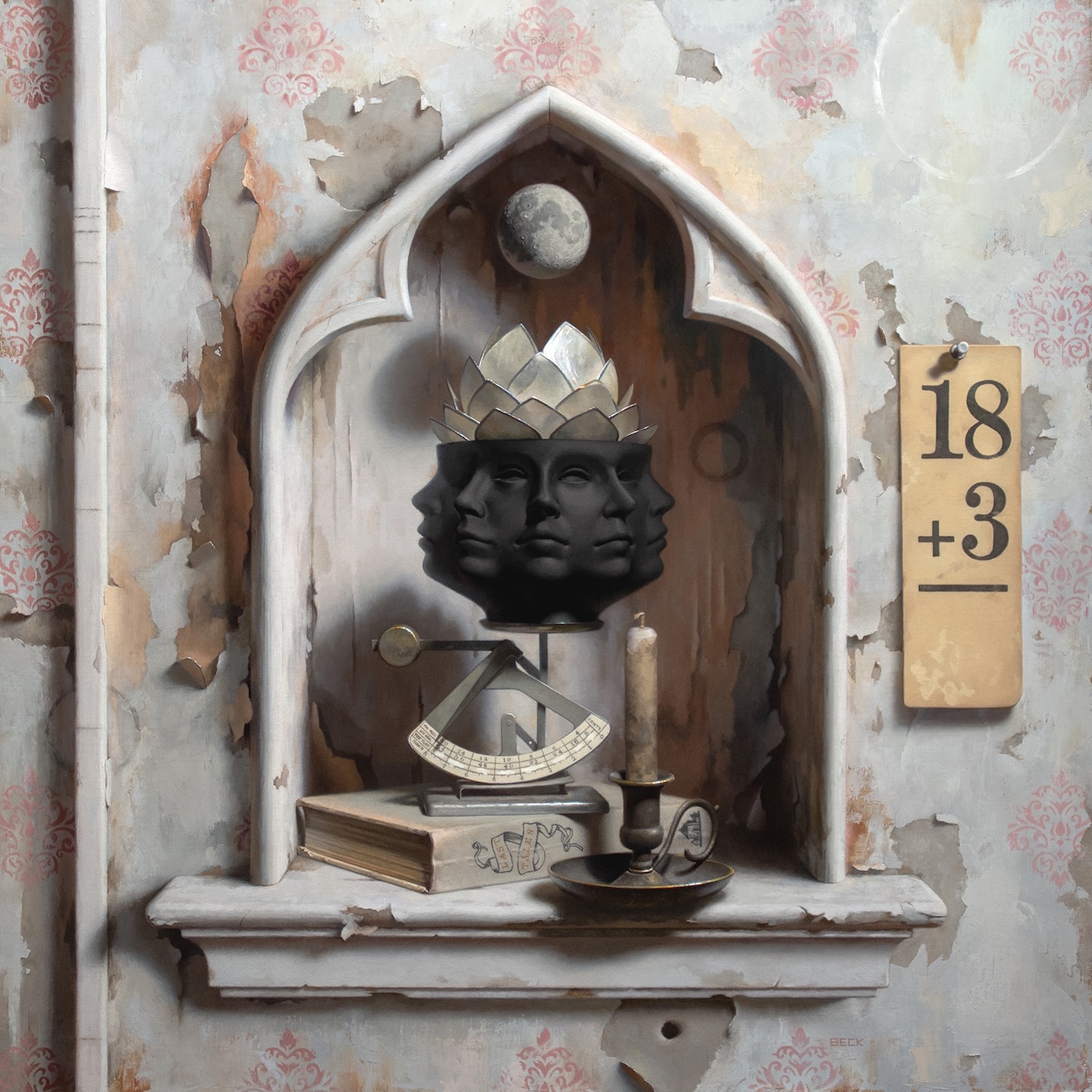
Ghost in The Machine, oil on canvas panel, 24x24 inches
-So much of what you paint feels like special treasures from a mid-century kitchen drawer. What draws you to that era, and what do you think those objects mean for viewers today?
I'm really attracted to objects that feel like they have a life beyond the painting. I spent a lot of time with my grandmother growing up, and I spent a lot of that time in her house, which was filled with objects from that era. It was a space where I felt comfortable, happy, and loved, so I think some of that feeling naturally carries over into the things I'm drawn to paint.
The objects from that period were designed differently than they are now. There was so much attention given to the shape, color, materials, and overall character of even very ordinary household things. They were made to be useful, but they were also designed with a sense of beauty and personality. A lot of objects today seem much more focused on mass manufacturing, efficiency, and temporary use. I find myself drawn to things that feel like they were meant to stick around.
And I especially love objects that feel lived with. I'm interested in the little signs of use—the wear, imperfections, patina, or alterations that happen over time. Those things give an object character and make it feel as though it has a life of its own. In a way, I'm attracted to objects that have stories before they ever make it into one of my paintings.
I don't necessarily want every object to have one fixed meaning. I like leaving breadcrumbs. Sometimes I know exactly why I've included something, and sometimes I discover that meaning through the process of painting. My setups are intentionally constructed as interactions with the viewer rather than something that simply sits there waiting to be passively read.
I'm also interested in what happens when you take an ordinary object out of its ordinary context. Anything can suddenly become symbolic or at least make you wonder why it's there. I think those familiar objects give viewers an entry point. You recognize something immediately, and then hopefully you start asking yourself, “Wait, why is that next to that?” That's where things get interesting for me.
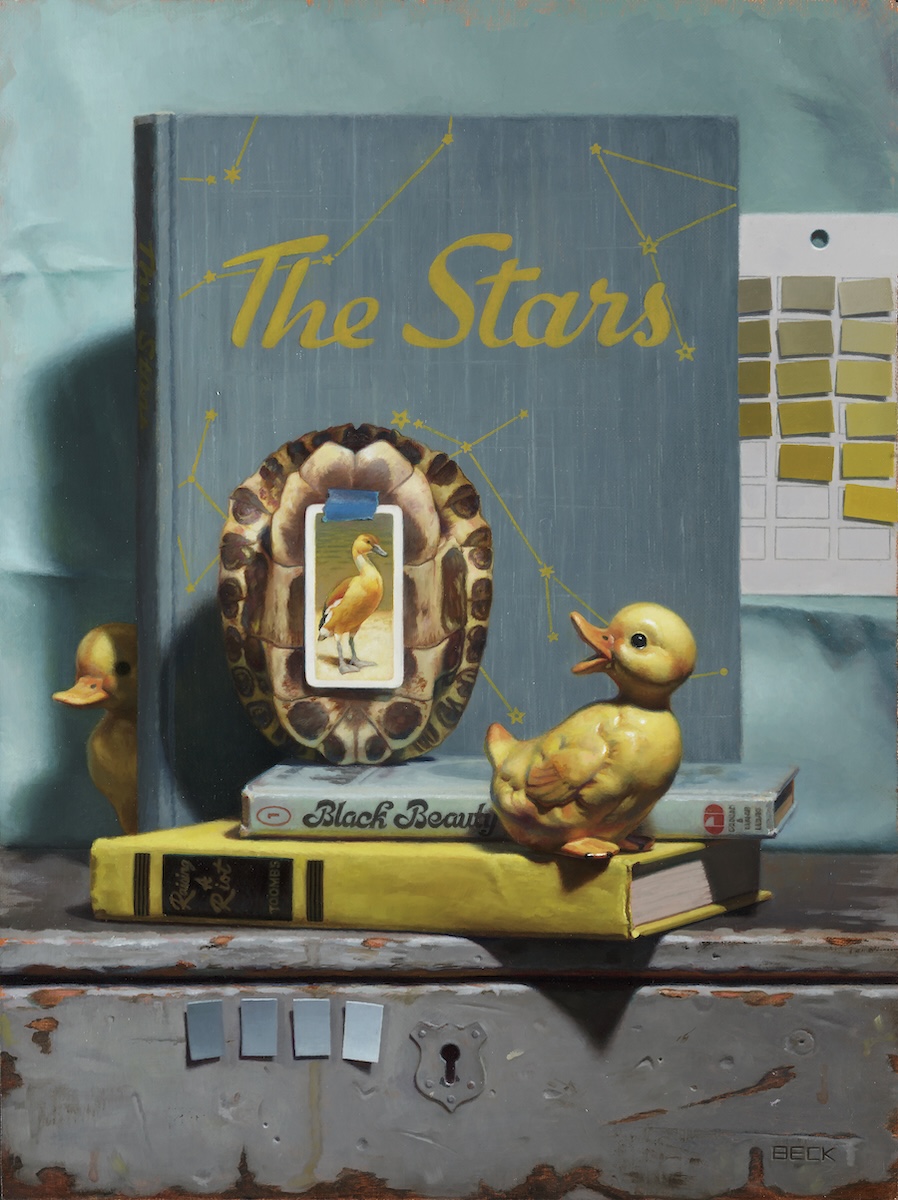
Duck and Color, oil on canvas panel, 12x16 inches
-I wonder how many people try to touch your paintings. Everything looks incredibly realistic. What details matter most to you when you're painting a surface?
I'm not really chasing detail for the sake of detail. The realism I'm interested in is more of a natural realism: the experience of actually looking at something rather than simply recording everything that's there.
But ultimately, the way I render something is always in service of the idea behind the painting. I'm trying to tell a story, and I think the technical decisions can act as very subtle arrows pointing the viewer toward the heart of that narrative. Where I put focus, where I soften an edge, how much detail I give something, or what I choose to leave out can all influence where the viewer looks and how they experience the story.
The act of editing, deciding which details are necessary and which aren’t, is so important. Sometimes adding more information can actually distract from what you're trying to say. I want the viewer to notice the things that matter without necessarily realizing that I've directed their attention there.
Because I often work from life, I'm responding to the actual objects in front of me rather than trying to reproduce an idealized version of them. I'm paying attention to the way light behaves across different materials, the quality of the edges, subtle shifts in temperature and value, and all those things that make an object feel physically present. But I'm also constantly asking myself: Does this help the story?
For me, that's where realism becomes really interesting. The technical decisions aren't separate from the concept, they're part of the narrative. The goal isn't to make everything equally convincing. It's to make the right things convincing in the right way, so that the realism itself helps lead the viewer toward the idea.
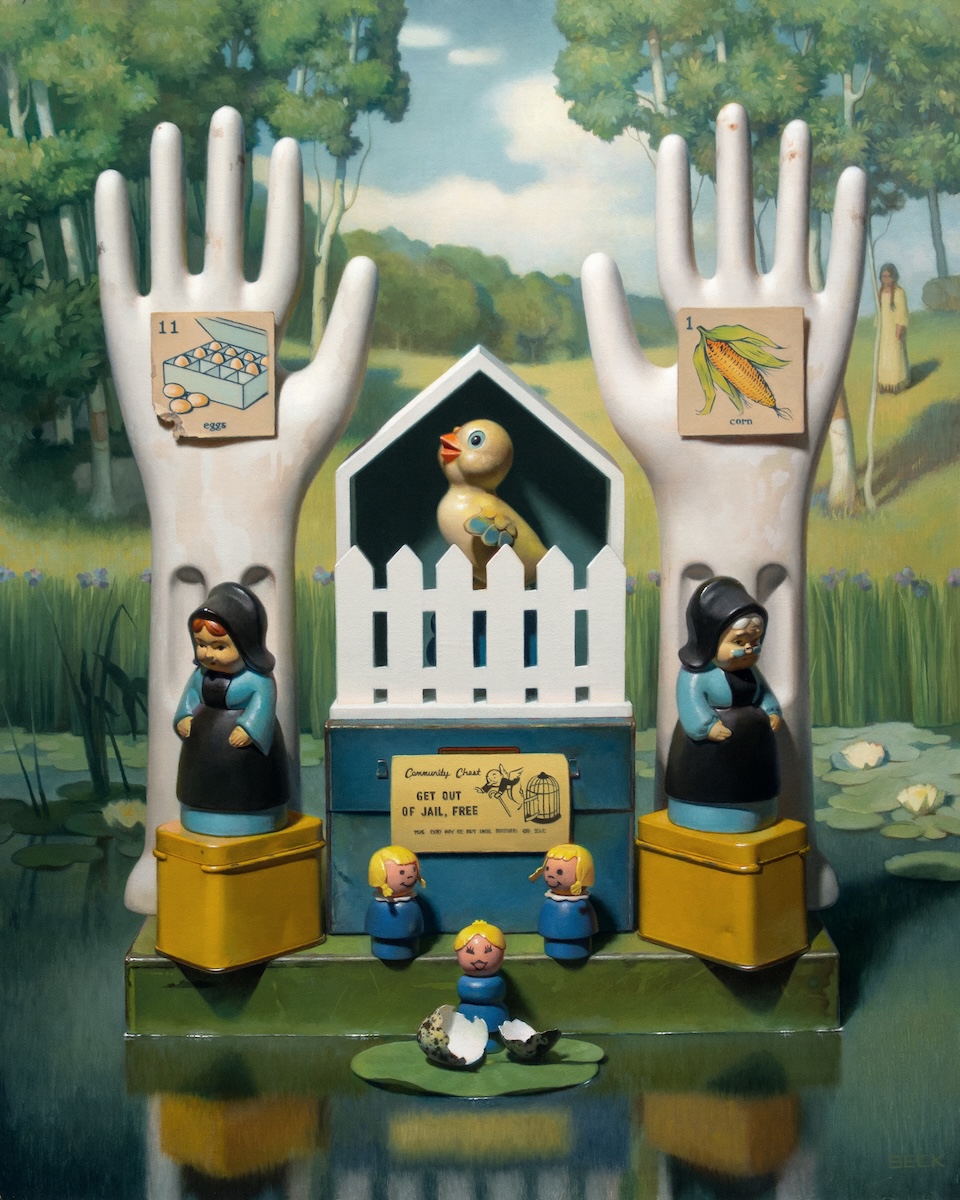
We Sing After the Storm, oil on canvas panel, 16x20 inches
-Pairs and mirrored figures show up in your work quite often. What does symmetry mean to you as a storyteller?
Symmetry is interesting to me because there’s an inherent sense of balance and predictability to it. I’m also a HUGE Wes Anderson fan, so I’ve always been drawn to that very deliberate, structured way of composing an image. It gives me a strong framework to push against. I can establish this sense of order and then introduce something that disrupts it.
Symmetry is everywhere in nature, but when you use it intentionally in a visual composition, it can create this almost iconic, altar-like feeling. That quality really interests me because it can make something feel important or even a little mysterious.
Pairs naturally become a useful visual language for that. They create a relationship between two things and invite you to start comparing them. They can suggest intimacy, competition, dependence, conflict, reflection, or even just that strange experience of seeing yourself in another person.
I’m also not trying to give people the feeling of just stumbling across some objects that happen to be together. There’s a very obvious staging and intention for many of the works, which begs the viewer to search for meaning/intention.
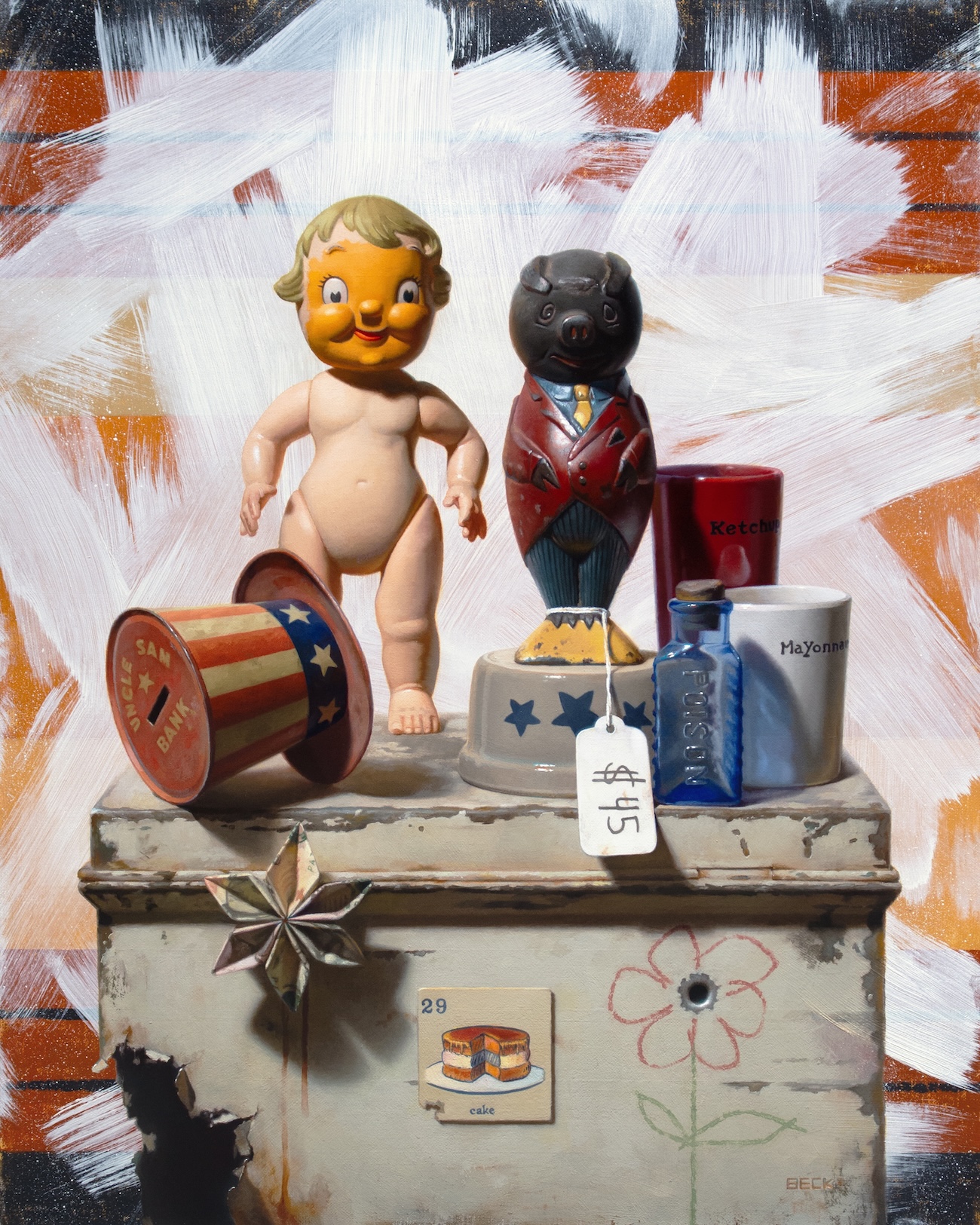
Too Many Flags, Not Enough We The People, oil on canvas, 16x20 inches
-What's the best way for someone to check out your work and provide support?
Honestly, the best way to support me is just to follow along and stay curious. I share new paintings, color studies, studio shenanigans, and exhibition news in my monthly newsletter and my social media.
Obviously, buying a painting or color study is a pretty fantastic way to support an artist! But showing up to an exhibition, sharing my work with someone who might connect with it, following along online, or even just telling me what a painting makes you think about all means a lot.
I’m lucky to have my work represented by galleries, so if you see something you like, you can always reach out to one of the galleries carrying my work—or get in touch with me through my website to see what’s currently available.
Mostly, though, I just want people to look at the paintings. Spend some time with them. See if they make you smile, raise an eyebrow, or stir up some little thought or feeling you weren’t expecting.
www.youtube.com/@JulieBeck(opens in new tab)
www.juliebcreative.com(opens in new tab)
www.mailchi.mp/7c5655e5067a/newsletter-sign-up(opens in new tab)
Statement
I use painting to create accessible work that relates the innate desire to connect. By manipulating design, composition, and narrative, I am able to intimate ideas that are either preconceived or find themselves in the process. My artistic impulse stems from a singular obsession with painting that I have realized cannot be denied. Whether poetic or polemical, my work strives to leave an impact on viewers that leaves them asking questions about the I use painting to create accessible work that reflects our innate desire to connect. I explore ideas that are sometimes carefully planned and other times discovered in the act of painting itself. My work invites viewers to question the relationships we build with each other, with our surroundings, and with ourselves.
Every object and figure is chosen with intention. Nothing is incidental. While each painting often begins intuitively, every decision is refined to serve the larger concept. Though grounded in realism, abstract principles shape the composition, creating visual tension, rhythm, and driving the viewer’s experience.
The humor and playfulness that often define my work act as an invitation rather than a conclusion. Beneath them lies an exploration of social and political ideas, balanced between ambiguity and intention. I aim to leave enough space for personal interpretation while scattering breadcrumbs that reveal my own perspective. Ultimately, I want my paintings to be visually compelling, emotionally resonant, and intellectually engaging. I strive to create work that feels at once familiar, surreal, and mysterious connections we find around ourselves.
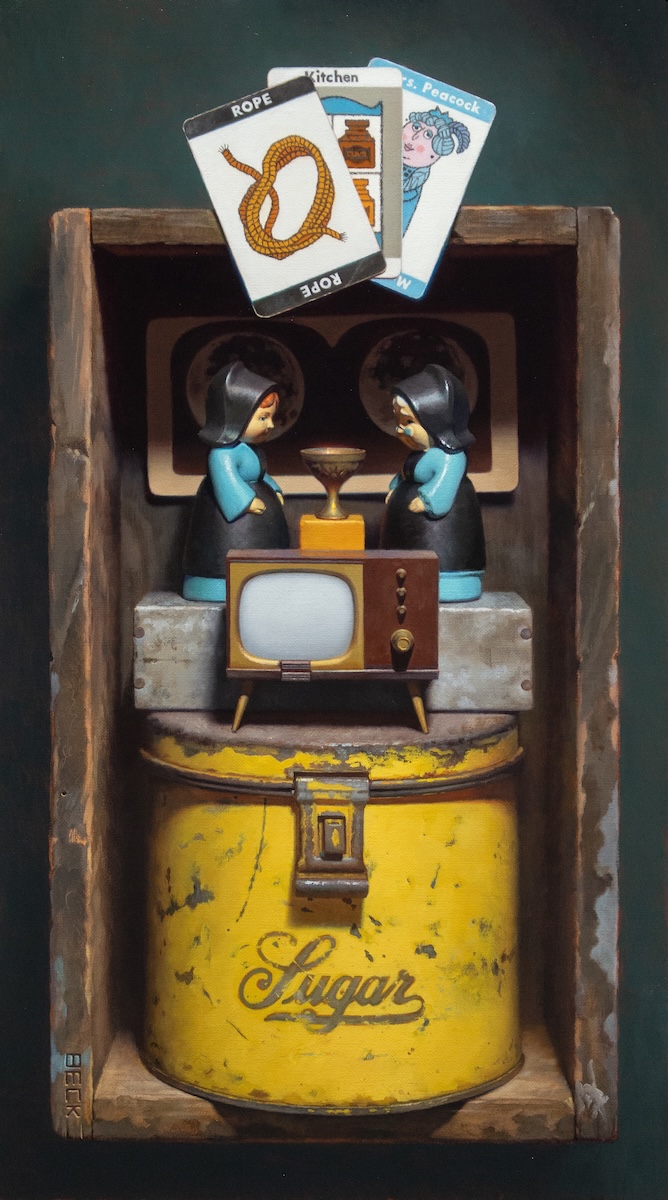
The Gravity She Holds, oil on canvas panel, 10x18 inches
Bio
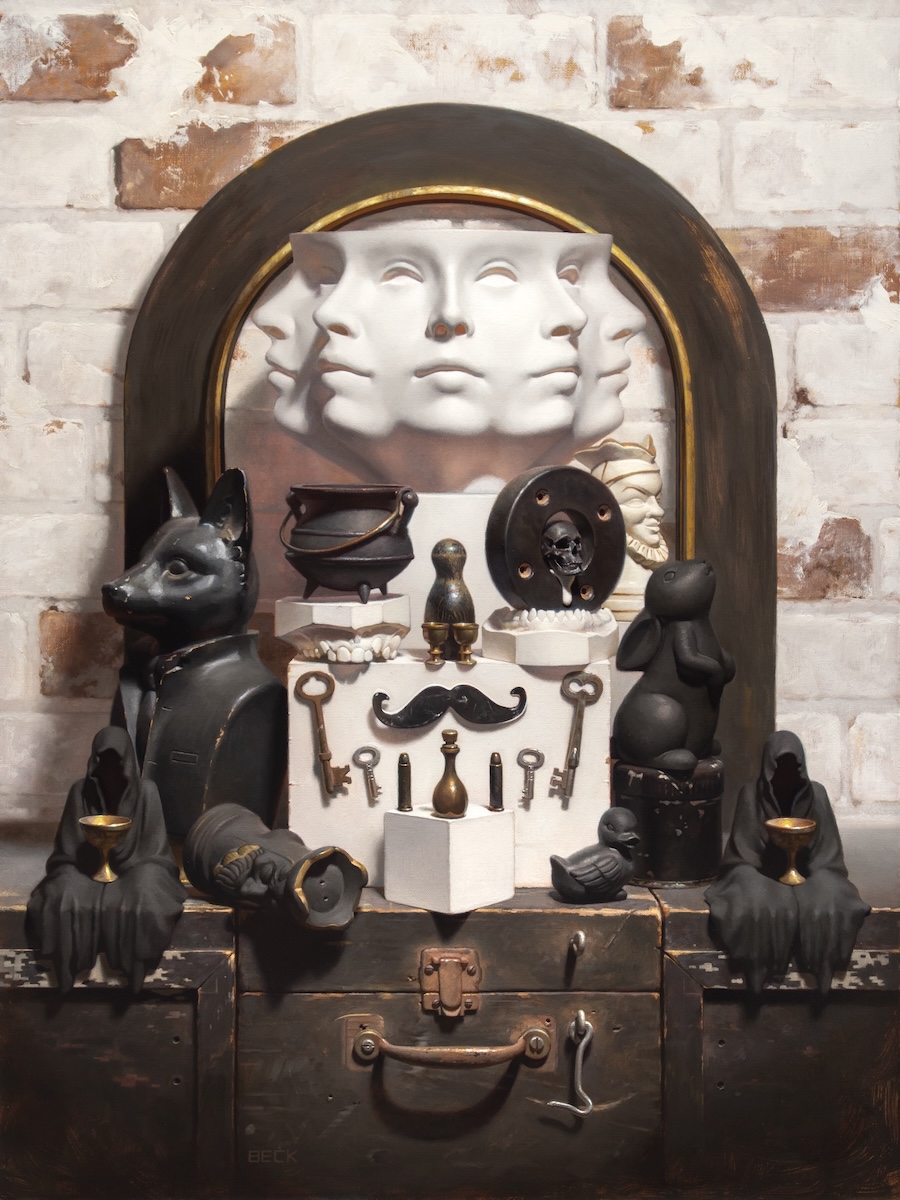
You Bring the Smile, I’ll Bring the Teeth, oil on canvas panel, 18x24 inches
Julie Beck was born and raised in Western Upstate New York. From 1998 to 2002, she attended Roger Williams University in Rhode Island where she graduated valedictorian with a Bachelor’s degree in Mathematics. From 2002 to 2011, she worked primarily as a freelance designer but continued to draw and paint as a self-taught artist. In 2011, a move to Massachusetts introduced her to the Academy of Realist Art, Boston which catapulted her abilities to a new level. Since then, Julie has become both an instructor at, as well as the Assistant Director of ARA Boston.
Julie is currently working out of her personal studio at ARA Boston, where she is developing a body of work that explores the concepts of nostalgia, relationships, and identity. Her work can be found in private collections throughout the US and internationally.